
Hybrid cars have become an important part of modern transportation, especially in the United States and the United Kingdom, where drivers increasingly look for vehicles that balance performance, efficiency, and environmental responsibility. While hybrid vehicles may appear complex at first glance, their underlying principles are logical and carefully engineered. By combining an electric motor with a gasoline engine and coordinating them through advanced control systems, hybrid cars aim to use energy more intelligently than conventional vehicles.
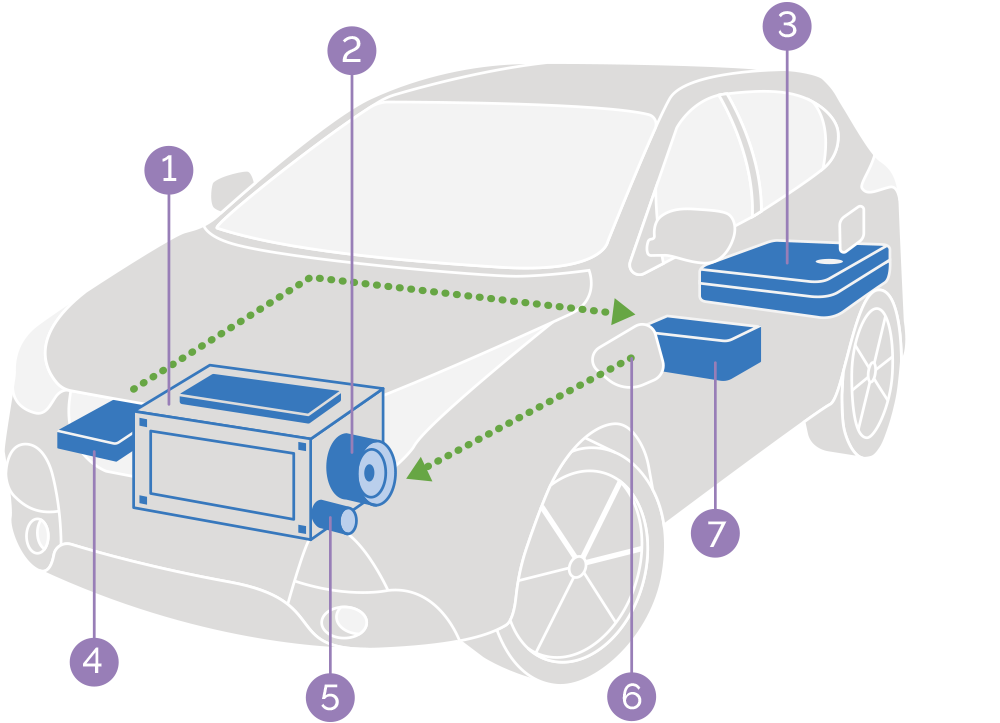
Hybrid cars have become an important part of modern transportation, especially in the United States and the United Kingdom, where drivers increasingly look for vehicles that balance performance, efficiency, and environmental responsibility. While hybrid vehicles may appear complex at first glance, their underlying principles are logical and carefully engineered. By combining an electric motor with a gasoline engine and coordinating them through advanced control systems, hybrid cars aim to use energy more intelligently than conventional vehicles.
The Core Components of a Hybrid Vehicle
The Role of the Electric Motor
The electric motor is a central element of any hybrid car. Unlike a traditional starter motor, it plays an active role in propulsion. The electric motor converts electrical energy stored in the battery into mechanical motion, which helps move the vehicle.
One of the key advantages of an electric motor is its ability to deliver smooth and immediate torque. This characteristic makes it especially effective during low-speed driving and initial acceleration. In many everyday driving situations, such as moving through traffic or cruising at moderate speeds, the electric motor can power the vehicle on its own or assist the gasoline engine.
In addition to propulsion, the electric motor often serves secondary functions. It can act as a generator during braking or deceleration, capturing energy that would otherwise be lost and converting it back into electrical energy. This dual-purpose design is a defining feature of hybrid systems and plays a major role in improving overall efficiency.
The Function of the Gasoline Engine
The gasoline engine in a hybrid car differs from that of a conventional vehicle, not necessarily in appearance, but in how it is used. Rather than running continuously, the engine operates only when its contribution is most effective.
Gasoline engines are generally more efficient when running at steady speeds under moderate loads. Hybrid systems take advantage of this by allowing the engine to operate in conditions where it performs best. When demand is low, the engine may shut off entirely, allowing the electric motor to take over. When more power is needed, the engine can restart seamlessly.
The gasoline engine may also play a role in charging the battery, either directly or indirectly, depending on the design of the hybrid system. This flexibility allows the vehicle to balance energy sources without relying on external charging in most cases.
Power Split and Energy Management
Understanding the Power Split System
At the heart of many hybrid vehicles is the power split system. This system determines how power from the electric motor and the gasoline engine is distributed to the wheels. Rather than treating the two power sources as separate, the power split system allows them to work together as a unified drivetrain.
The power split system can direct engine power to the wheels, to the generator, or to both at the same time. This capability allows the vehicle to adapt to different driving conditions smoothly. For example, during gentle cruising, the system may prioritize electric drive. During stronger acceleration, it may combine power from both sources.
What makes the power split system especially effective is its ability to change configurations without noticeable transitions. From the driver’s perspective, the vehicle behaves like a single, cohesive system rather than two separate powertrains working side by side.
Principles of Energy Management
Energy management refers to how a hybrid car decides when and how to use stored electrical energy and fuel energy. This process is handled by onboard computers that continuously monitor driving conditions, driver input, and system status.
The primary goal of energy management is efficiency, but it also considers performance and durability. The system aims to use electrical energy where it provides the greatest benefit and to rely on the gasoline engine when it is most appropriate. These decisions happen automatically and in real time.
Energy management also ensures that the battery operates within a suitable range. Rather than allowing the battery to become fully depleted or overly charged, the system maintains balance to support long-term reliability. This careful control is one reason hybrid vehicles can operate consistently over many years.
Driving Modes and Real-World Operation
Electric-Only and Hybrid Driving Modes
Hybrid cars are capable of operating in different driving modes, even if the driver is not always aware of the transitions. In electric-only mode, the vehicle relies entirely on the electric motor. This mode is most common during low-speed travel or light acceleration.
In hybrid mode, the electric motor and gasoline engine work together. This combined operation allows the vehicle to meet higher power demands while still managing energy efficiently. The transition between modes is typically smooth and designed to be unobtrusive.
Some hybrid vehicles allow drivers to select specific driving modes, such as efficiency-focused or performance-oriented settings. These modes adjust how aggressively the system uses the electric motor and gasoline engine, but the underlying principles of coordination remain the same.
Regenerative Braking and Energy Recovery
One of the most distinctive features of hybrid cars is regenerative braking. In a conventional vehicle, braking converts motion into heat, which is dissipated and lost. In a hybrid vehicle, some of that motion is converted into electrical energy instead.
When the driver slows down or applies the brakes, the electric motor operates as a generator. It captures kinetic energy and stores it in the battery for later use. This process improves overall efficiency and reduces reliance on the gasoline engine.
Regenerative braking also changes the driving experience slightly. The braking feel is carefully tuned so that drivers experience a natural response, even though part of the braking force comes from energy recovery rather than friction alone.
System Integration and Intelligent Control
Coordinating Multiple Systems
Hybrid cars rely on a high level of system integration. The electric motor, gasoline engine, battery, transmission, and control electronics must all work together seamlessly. This coordination is managed by sophisticated software that processes information from numerous sensors.
System integration ensures that power delivery feels consistent and predictable. It also allows the vehicle to respond quickly to changing conditions, such as sudden acceleration or changes in road grade. Without effective integration, the benefits of hybrid technology would be difficult to achieve.
This integrated approach also simplifies operation for the driver. Despite the complexity behind the scenes, driving a hybrid car is generally no different from driving a conventional vehicle. The technology is designed to support the driver, not distract from the experience.
Reliability and Long-Term Operation
Another important aspect of system integration is reliability. Hybrid systems are designed with redundancy and protective strategies to ensure stable operation over time. If one component is under stress, others can compensate temporarily.
The control system also monitors component health and operating conditions. By adjusting how and when each part is used, the system can reduce wear and maintain consistent performance. This approach supports long-term durability without requiring special driving behavior from the owner.
Questions and Answers
Q: Do hybrid cars switch between electric and gasoline power automatically?
Yes. The transition between electric motor use and gasoline engine use is handled automatically by the vehicle’s control system. Drivers do not need to manage this process themselves.
Q: Is the electric motor only used at low speeds?
No. While the electric motor is especially effective at low speeds, it can also assist the gasoline engine during acceleration and cruising, depending on driving conditions.
Q: How does energy management affect the driving experience?
Energy management works in the background and is designed to be seamless. Most drivers are not aware of when energy sources change because the system prioritizes smooth operation.
Q: Are hybrid systems complicated to maintain?
From a driver’s perspective, maintenance is similar to that of conventional vehicles. The complexity is managed by the vehicle’s design and control systems rather than by the owner.